This is something I have frequently searched, and the answers have basically non-existent. So I thought I would walk you through my research process. I am not a lawyer! I am a librarian, nerd, and knitter. This also applies to US copyright only. And it’s hard! Tracking down the copyright for a book, especially when you don’t know the registration number, is very difficult but not impossible.
US copyright law is pretty intense, but for this I am just focusing on patterns published prior to 1963. Why you ask? Books published 1930 or earlier are definitely in the public domain. Every year from now until 2073, books will automatically enter the public domain 95 years after publication.
But there is a gap between 1930 and 1963. Books published prior to 1978 had a copyright term of 28 years, then they had to be renewed if they wanted to keep the copyright for an additional 28 years. If they didn’t, they fell into the public domain. Congress passed legislation for all books published on or after January 1, 1978 that did away with renewal and lengthened the copyright term to 75 years. In 1992 they retroactively did away with the need for renewal for any book published on or after January 1, 1964. So those gap years fall into a nebulous zone where in order to keep the copyright you had to renew it 28 years after the initial publication date and within one calendar year of that anniversary.
Lets follow this research process for one of my knitting books: Jack Frost Blouse Book Volume 43.
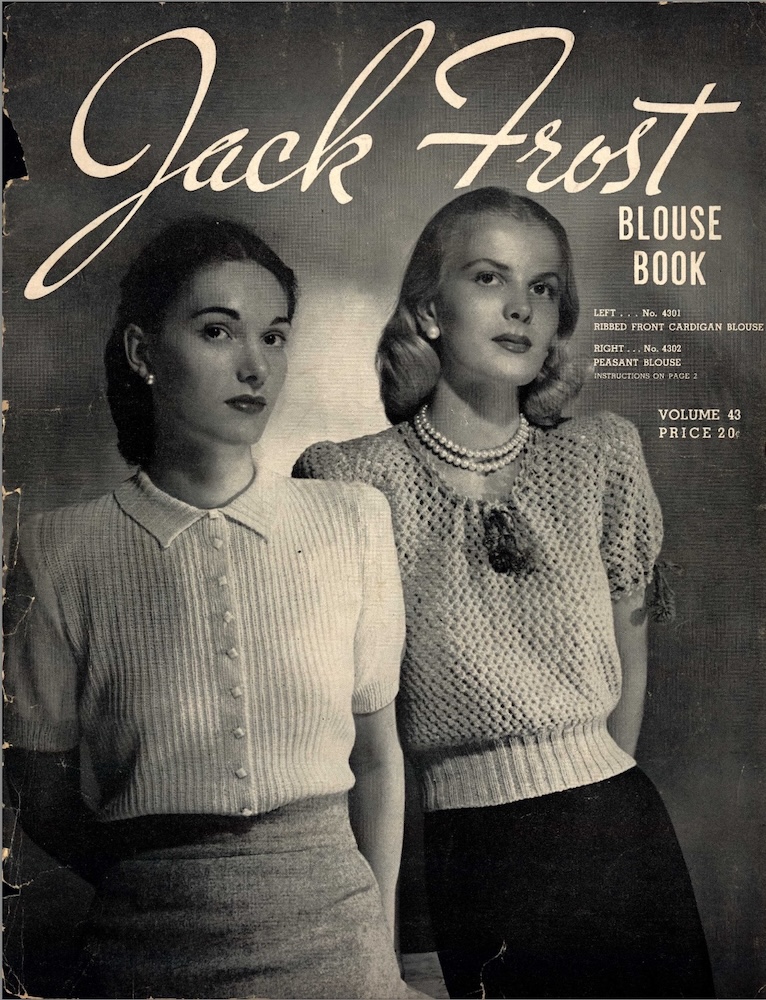
All books published prior to February 28, 1989 were required to include a copyright notice. In this book it’s on the inside cover:
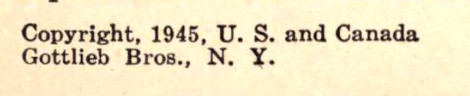
That is sufficient to have a copyright claim. You didn’t have to register the copyright with the US Copyright Office, but many did. I looked up the original copyright in the US Copyright public records system:
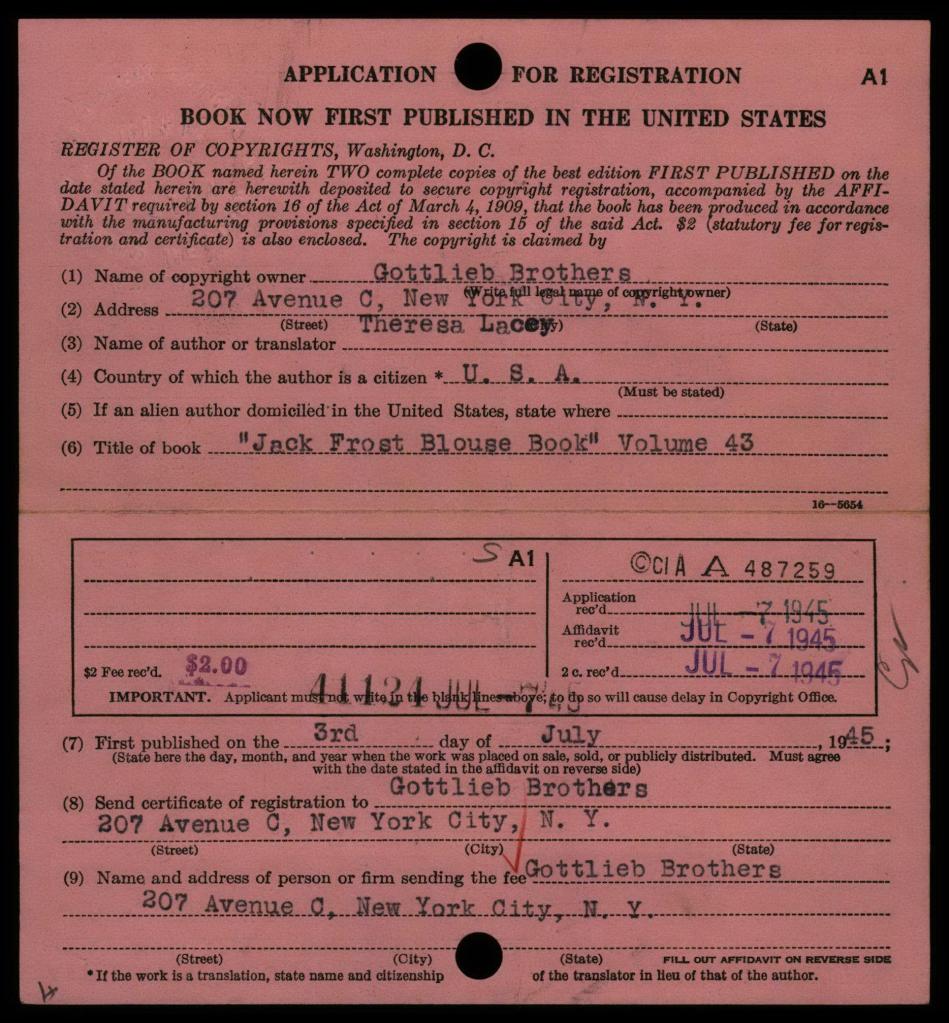
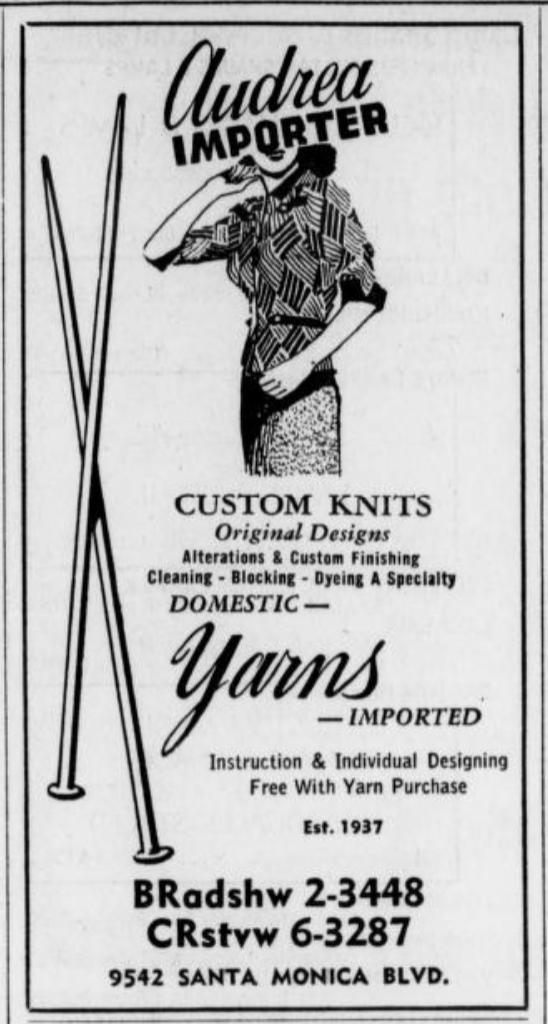
As a fun aside, this copyright registration reveals the author (or possibly editor) of the book to be Theresa Lacey. As I wrote with Audrea of Hollywood, knowing the people behind the patterns in this era is exceedingly rare. Of course, she wasn’t credited in the booklet, but I like knowing her name now.
The original card above is their application, but it does have the copyright class (AA) and number (487259). The card is just the app, but this image below is the actual entry in the copyright record book:
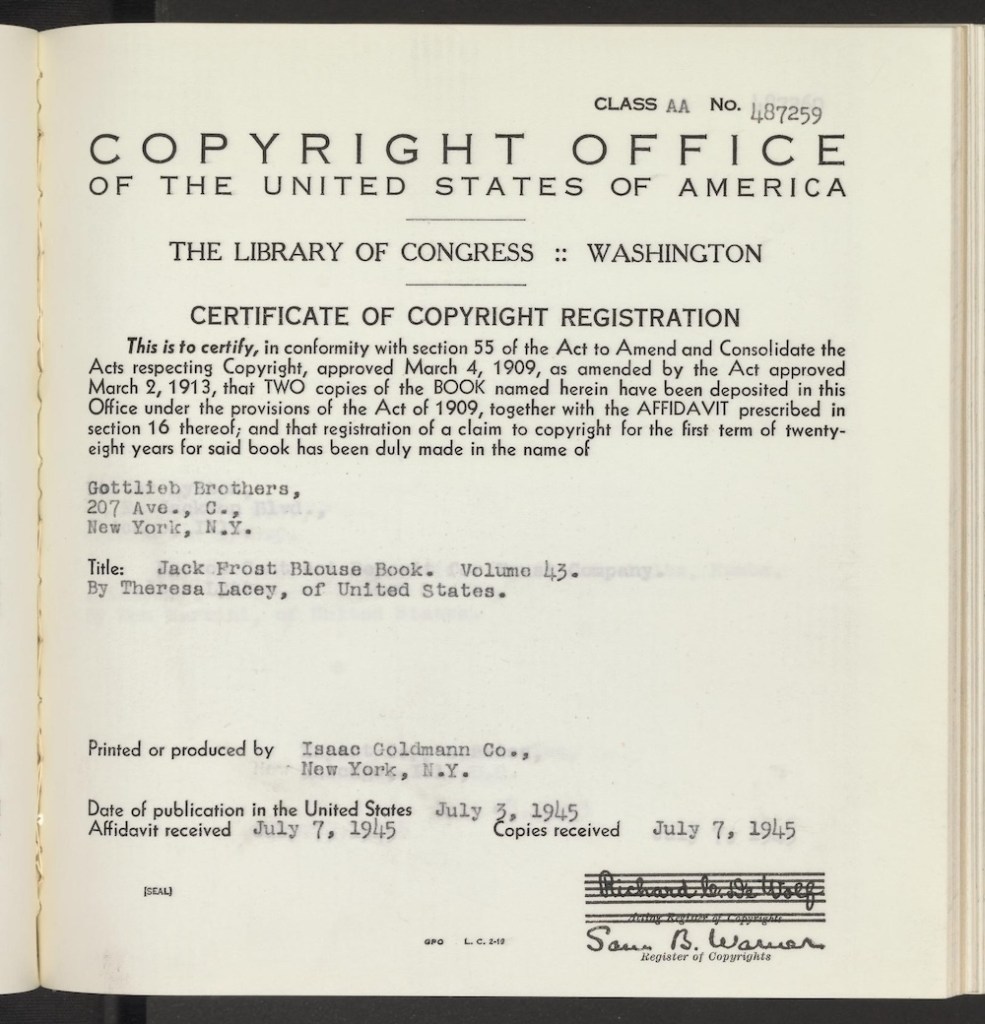
If you don’t have the registration number, finding the actual registration is a nightmare. Right now I am researching a few books published in 1948. There are 76 volumes of these copyright registrations, each with about 1,000 pages, that are organized by registration number not registrant or title. Thankfully, there is an index, but that can be kind of hit and miss in terms of searchability. Research is so fun, right?
Anyways, the application and registration record say it was first published on July 3, 1945, so the copyright would be valid until 1973. There are many ways to check if they renewed the copyright. UPenn has digitized copyright registration and renewals records, searchable by year. Project Gutenberg has a searchable file of copyright renewals 1950-1977. Stanford has a searchable database of all copyright renewals from 1926-1963, specifically for people searching for Class A copyright information for that window of time.
What if they renewed the copyright? Well since the work was published in 1945, it could have been renewed in 1973 or 1974 (within the one-year window). Even so, I check the year before, the year, and the year after just to be safe! Plus I searched the Stanford index and and Project Gutenberg to be thorough. I found their new copyright registrations, but no renewals. Hooray! It’s public domain!
So why didn’t they renew the copyright?
In 1973 there were 23,071 renewals for all classes and in 1974 there were 25,464—both up from previous years, and there is an interesting bit in the renewal section of the 1974 annual copyright report about a 1973 lawsuit concerning the ownership of Superman (77th Annual Report, 1975).
I think it makes total sense that they wouldn’t renew the copyright. These days, patterns are a designer’s stock-in-trade. They showcase their creativity, writing skills, and ingenuity. Historically patterns were primarily published as a way to sell yarn. Every vintage pattern book I can think of was published by a yarn company. Additionally, the patterns needed to be renewed in the 1970s. While it’s possible they might have taken some fashion inspiration from the 1940s, it was a very different cultural period. If these yarn manufacturers were looking to sell yarn, they needed current designs with their current yarn lines.
Another consideration is cost. To register the book initially, you can see on the application that they paid a $2 fee (just north of $36 in 2026 dollars), and the 1974 annual copyright report renewals were $4 (or $26-ish in 2026 dollars). If a company was publishing a lot of books, I could see the price of original copyrights ($6 per registration) and renewals adding up. Maybe? I really don’t think cost was the major issue.
Overall, very far fewer AA copyrights were renewed than A copyrights. Class A was for more traditional books, and class AA was for “pamphlets, small books, leaflets, etc.” United States Copyright Office (n.d.). It was established in 1909 and was discontinued in 1952. These just weren’t seen as worth preserving in the same way as traditional print books. One series whose copyright was renewed is Vogue Knitting by Ruth Seder Cooke with the copyright held by Condé Nast. Good for them! Those are great books and they must have seen the potential in a library of patterns. Additionally, the creation of the patterns was likely seen as “for hire” work (as with the original creators of Superman) so the people (women, usually) who wrote the patterns had no claim to the work.
Great! It’s public domain. Now what?
Well, you can do whatever you want with it! Whenever I buy a vintage pattern book, the first thing I do is scan it. I know I am too clumsy to be trusted with a fragile paper pattern, and it is far easier for me to read and reference a digital copy. I, for one, like to share things, hence this now available on Stitch Book and the Internet Archive. I have added a page with my Free Knitting Books for you to peruse as well. I hope you enjoy!
Click for references


 Knitting Math